0498 70 98 60
WordPress Agency Los Angeles: Fast Sites for Media, Video, and Consumer Brands
Picture a skincare brand in the Arts District launching a new serum: a looping video on the homepage, 40 product shots, and a gallery of creator content. On the creative director’s laptop, it looks flawless. On a mid-range Android phone in Koreatown, the hero video stalls, the layout jumps when the reviews widget loads, and “Add to Cart” reacts a beat too late. A WordPress agency Los Angeles brands work with should catch that before launch, not after the ad budget starts running.
We build and maintain WordPress sites for media companies, studios, and consumer brands whose message lives in images and video: performance work, headless builds when they make sense, WooCommerce, consent, and accessibility. A design-led redesign belongs with our Los Angeles web design team, part of our wider web design agency services. If your site has been compromised, our hacked WordPress repair service in Los Angeles is the faster route.
Référenceur is a French-speaking team with offices in Belgium and Luxembourg, where strict cookie-consent rules have shaped every website we’ve built for years. That background helps in California, where regulators now examine how consent tools behave, not just whether a banner exists. Behind that sit more than 15 years of client work, 107 Google reviews averaging 4.7/5, and a fully remote way of working with U.S. brands.
Core Web Vitals When Your Site Runs on Video and Photography
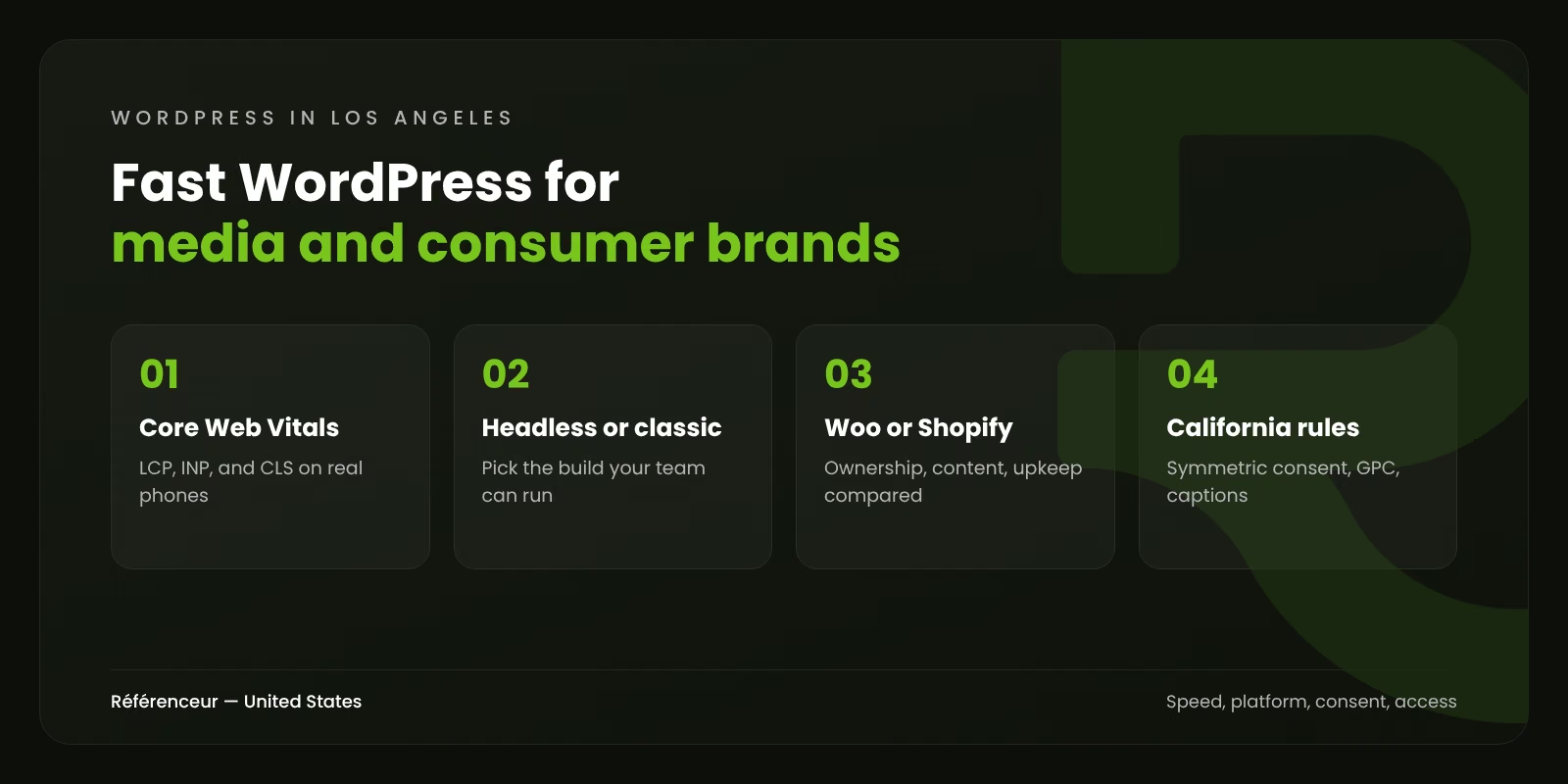
Google measures page experience with three Core Web Vitals, judged on real Chrome visits at the 75th percentile. A good score means a Largest Contentful Paint (LCP) of 2.5 seconds or less, an Interaction to Next Paint (INP) of 200 milliseconds or less, and a Cumulative Layout Shift (CLS) of 0.1 or less. INP took over from First Input Delay as a Core Web Vital on March 12, 2024, and on visual sites it’s easy to miss: heavy scripts make every tap feel sluggish without throwing any visible error.
Image- and video-heavy WordPress sites tend to fail in the same places:
- The hero image is lazy-loaded, which delays LCP. The first visible image should load right away with a high fetch priority; everything below the fold can wait.
- Video embeds load the full player as the page opens. A poster image that loads the player on click keeps the first screen light.
- Images and embeds have no set dimensions, so the layout jumps as they arrive and CLS climbs.
- Social feeds, review widgets, and chat scripts compete for the main thread and drag INP down.
- Photos go up straight from the camera. We convert them to AVIF or WebP and let WordPress serve the right size to each screen.
WordPress 7.0, released May 20, 2026, lets editors show or hide blocks by device. It’s handy for trimming a mobile layout, but a block hidden this way stays in the page’s HTML and is hidden with CSS, so we still check what the phone actually downloads. Our Core Web Vitals checklist covers the full method.
Headless WordPress: When It Pays Off and When It Doesn’t
A headless setup keeps WordPress as the place where editors write, while a separate front end, often built with a JavaScript framework such as Next.js, pulls content through the REST API or GraphQL. It can be very fast. It also changes how your whole team works.
| Question | Traditional WordPress | Headless WordPress |
|---|---|---|
| Editorial preview | Built in | Has to be rebuilt for the new front end |
| SEO, forms, and consent plugins | Work as installed | Their output must be recreated in the front end |
| Hosting | One environment | Two, each with its own deployments |
| Team needed | WordPress developer | WordPress plus front-end JavaScript developers |
| Best fit | Brand sites, studios, most stores | Publishers feeding web, apps, and other screens from one source |
Headless earns its cost when one content library feeds several outputs, or when your brand already employs front-end engineers. For a 25-page studio site or a typical store, a well-tuned traditional WordPress theme built with blocks can often reach comparable speed with far fewer moving parts.
WooCommerce or Shopify for a Los Angeles Brand
It’s one of the first decisions a fashion, beauty, or food brand faces, and neither platform wins everywhere.
| Criterion | WooCommerce | Shopify |
|---|---|---|
| Ownership | Your hosting, your database, your code | A hosted platform with its own terms |
| Content and storytelling | Full WordPress editor for lookbooks, journals, and campaign pages | Simpler content tools, often extended with apps |
| Maintenance | Updates and testing are your responsibility | Platform updates handled for you |
| Customization | Almost anything, with development time | Within the platform’s limits and app ecosystem |
| Fees | Hosting, extensions, and your payment processor | Subscription plan plus payment fees that vary by plan and provider |
Some brands run both: Shopify for checkout and inventory, WordPress for the editorial content that wins search traffic. Whichever you choose, category pages and product content still decide how you rank, which is where our ecommerce SEO in Los Angeles comes in.
Cookie Consent on WordPress Under California Privacy Rules
California’s privacy law (the CCPA, expanded by the CPRA) lets residents opt out of the sale or sharing of their personal information, and the California Privacy Protection Agency enforces it. In March 2025, the agency announced a settlement with American Honda Motor Co. One issue was its cookie tool: accepting advertising cookies took one click, while declining took two steps. The order required a “Reject All” option that mirrors “Allow All” and recognition of Global Privacy Control signals.
On WordPress, consent usually breaks in ordinary ways. A consent plugin is installed, but a pixel sits hardcoded in the theme header. YouTube embeds drop cookies before anyone clicks. Someone adds a TikTok or Meta pixel through a separate plugin that bypasses Google Tag Manager. The browser’s Global Privacy Control signal is never read. We inventory every tag, route them through Tag Manager with consent settings, and test the site in a browser with Global Privacy Control turned on. We handle the technical side only. Which obligations apply to your business is a question for your attorney; this isn’t legal advice. To see what your own site sends before consent, ask us for a tag review.
Accessibility Claims in California: Where the Unruh Act Comes In
California’s Unruh Civil Rights Act makes a violation of the Americans with Disabilities Act a violation of state law as well, and it carries statutory damages for each violation. That’s why accessibility claims against California businesses often cite both laws.
The courts have drawn a line. In Martinez v. Cot’n Wash, decided August 1, 2022, a California Court of Appeal held that a website with no connection to a physical place isn’t covered by ADA Title III, so the Unruh claim built on it failed. Seyfarth Shaw’s March 2026 report counted only four federal website accessibility suits in California in 2025 and attributed that low number to rulings like this one. A brand with a flagship store, a showroom, or a screening room is in a different position. Also, demand letters and state court filings don’t show up in federal counts.
For media-heavy sites, the practical work is specific: captions on every video with speech, transcripts for podcasts, a visible pause control for autoplaying backgrounds, carousels usable from the keyboard, and alt text written for product shots rather than generated filenames. For the standard itself, read our practical WCAG guide for U.S. businesses. Consider this general information rather than legal advice, and run your own case past counsel.
Working Alongside Your Creative Team
Many Los Angeles brands already have a creative agency or in-house designers. We slot in as the WordPress developer Los Angeles creative teams hand their design files to: we build custom blocks that match the design system, set up staging and version-controlled deployments, and hold every template to an agreed performance budget. After launch, our WordPress maintenance LA plan covers weekly updates of core and plugins, off-site backups with tested restores, uptime alerts, and a monthly Core Web Vitals review.
Everyone on your project is based in Francorchamps, Belgium, or Wemperhardt, Luxembourg, typically nine hours ahead of Pacific Time. We book calls for your early morning, when our day is winding down. The rest of the time, work moves forward while Los Angeles sleeps, so a release prepared overnight is ready for review when you open your laptop. No U.S. office, no American clients claimed: the brands in our case studies are European.
Coming from Belgium and Luxembourg, where French and English share most of our working days, we’re used to building one site for buyers in several countries, which helps when your brand also sells in France or Quebec. SEO, paid media, and social are covered by our Los Angeles digital marketing services. Want to know how your homepage scores on a real phone? Request a free assessment: we’ll test your key templates on mobile and review your consent setup.
Frequently Asked Questions About WordPress Development in Los Angeles
Will Going Headless Hurt Our SEO?
It can, if the new front end forgets what WordPress plugins used to handle: title tags, canonical URLs, structured data, XML sitemaps, and redirects. None of that is hard to rebuild, but it has to be on the project plan from the start. We also make sure the main content is present in the HTML the server sends, not only after JavaScript runs.
Can WordPress Handle a Product Drop With Heavy Traffic?
Yes, with preparation. Full-page caching and a content delivery network absorb most of the load, but cart and checkout pages can’t be cached, so the database and server have to cope on their own. Before a planned drop, we load-test those pages, remove nonessential scripts, and agree with your host on extra capacity for the day.
Should We Host Our Videos in the WordPress Media Library?
Usually not. Large video files strain ordinary WordPress hosting and don’t adapt their quality to each visitor’s connection. A dedicated video platform or streaming service handles encoding and delivery, while WordPress embeds the player behind a light poster image. Short, silent background loops are the exception, as long as they’re compressed and have a pause control.
Do We Need a “Do Not Sell or Share” Link on Our Site?
It depends on whether the CCPA applies to your business and whether your tracking counts as selling or sharing personal information. Many ad pixels raise that question. We can map what your site sends to whom and set up the link, banner, and signal handling, but whether you need them is a call for your attorney. This is not legal advice.
Can We Move From Shopify to WooCommerce, or the Other Way Around?
Yes. Products, customers, and order history can be migrated, and the work that matters most for search is mapping every old URL to its new address with permanent redirects. We plan the move outside your busy seasons and keep the old store available until the new one has processed real orders.