 0498 70 98 60
How to Respond to Negative Reviews: A Framework With Real Examples
Updated October 31, 2026
Learning how to respond to negative reviews matters because every business that serves enough customers will eventually get a harsh one. A late delivery, a misunderstanding about price, a bad day for an employee, or sometimes a review from someone who was never a customer at all. The review itself is rarely what decides your reputation. What prospects remember is how you answered it.
A calm, specific reply can turn a one-star review into proof that a real person runs the business and fixes problems. A defensive or sarcastic one can cost you more customers than the review ever would. This guide explains how to respond to negative reviews step by step, with response examples for common situations, the U.S. rules you need to respect, and what to do about reviews that are fake.
Why Your Reply Matters More Than the Review
Think about who reads your reply. It’s not mainly the unhappy reviewer; their opinion may not change. It’s the dozens or hundreds of future customers who scroll through your reviews before calling you. They’re looking for two things: whether the problem described is likely to happen to them, and how you behave when something goes wrong.
Google also encourages businesses to respond. Its Business Profile help pages describe replying to reviews as a way to build trust with customers, and Google lists review count and rating among the factors in local ranking. Replies don’t change your star rating, but they shape how that rating is read.
Before You Reply: Four Quick Checks
- Cool down. Never reply in the first hour if the review made you angry. Draft, wait, reread.
- Check whether this was a real customer. Search your records by name, date, and details. If you can’t find any trace, the review may violate Google’s policies (see the section on fake reviews below).
- Check for policy violations. Hate speech, personal information, conflicts of interest, off-topic rants, and spam can be reported. A review you simply disagree with can’t.
- Check your confidentiality obligations. Healthcare providers, lawyers, financial advisers, and others must not reveal client information in public, even to correct the record.
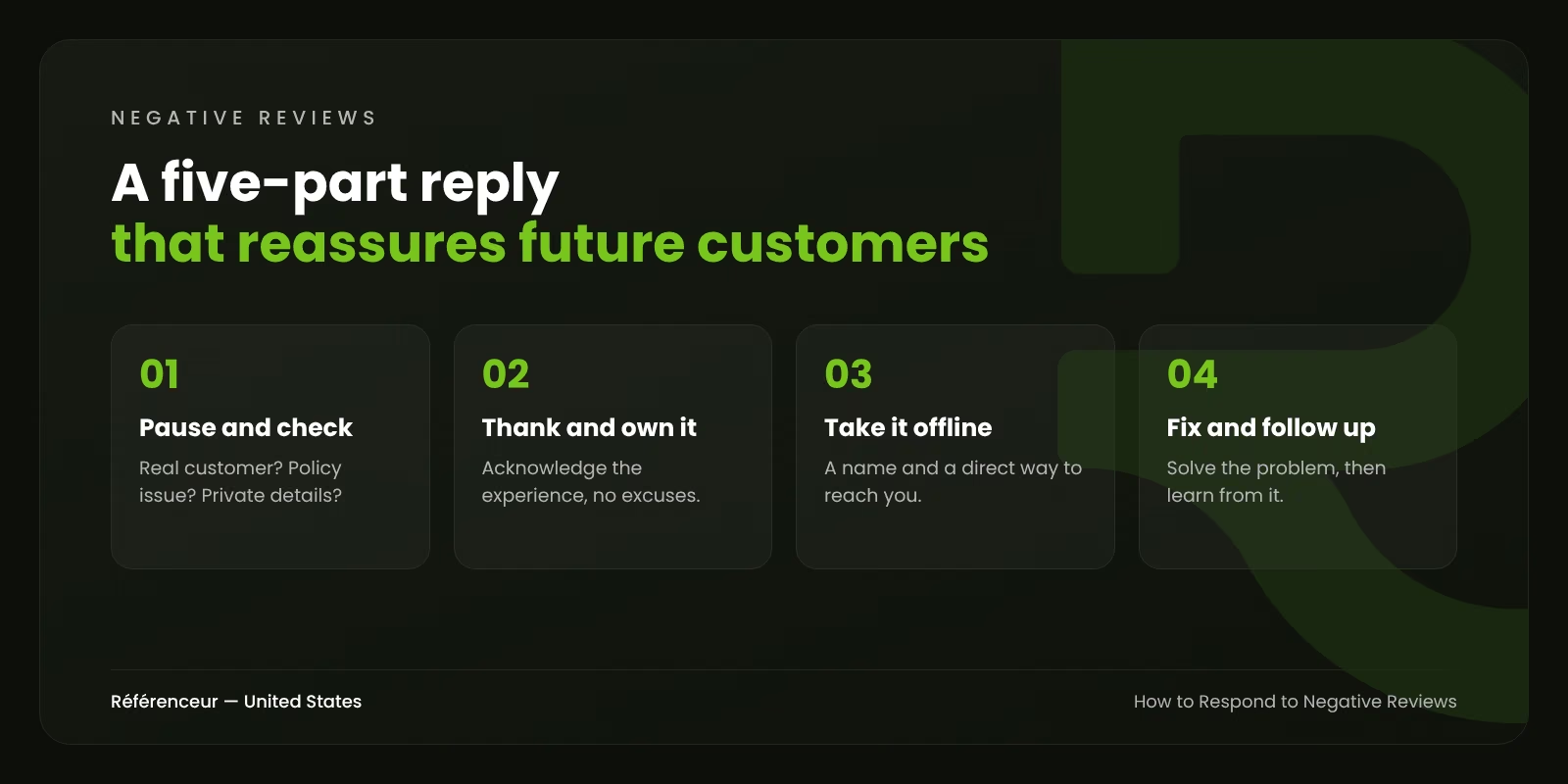
The Five-Part Framework for Responding to Negative Reviews
Most effective replies follow the same structure. Keep it short, usually three to five sentences.
- Thank them, by name if the name is public. “Hi Dana, thank you for taking the time to share this.” It signals you’re not defensive.
- Acknowledge the specific experience. Refer to what they actually described: the wait, the cold food, the missed appointment. Generic apologies read as copy-paste.
- Take responsibility where it’s due, without excuses. “That’s not the standard we hold ourselves to” works better than three sentences about staffing shortages. If the facts are disputed, stay neutral: “We see this differently, and we’d like to understand what happened.”
- Move the conversation offline. Give a name and a direct phone number or email address. Avoid long back-and-forth exchanges in public.
- Follow through. Actually call or email. If you resolve the issue, the reviewer may update the review on their own. Never pressure or pay them to do so.
Negative Review Response Examples
Adapt these templates to your voice and to the details of each review. Don’t paste the same reply under every review; prospects notice.
| Situation | Example reply |
|---|---|
| — | — |
| Slow service or delay | “Hi Marcus, thank you for the feedback. Waiting 40 minutes past your appointment time isn’t acceptable, and I’m sorry we did that to you. We’ve changed how we schedule Friday afternoons. I’d like to make this right; please call me directly at [number]. – Jen, Office Manager” |
| Price or billing complaint | “Hi Laura, thanks for raising this. Unexpected charges are frustrating, and we clearly didn’t explain the estimate well enough before the work started. I’d like to walk through the invoice with you. You can reach me at [email]. – Tom, Owner” |
| Rude or unhelpful employee | “Hi Chris, I’m sorry about the way you were treated at the front desk. That isn’t how we want anyone to feel here, and I’ve spoken with the team. If you’re willing, I’d appreciate hearing more at [number]. – Sam, General Manager” |
| Reviewer you can’t identify | “Hi Pat, thank you for your review. We take feedback seriously, but we couldn’t find a record of your visit under this name. Could you contact us at [email] so we can look into it? – The [Business] Team” |
| Healthcare, legal, or other confidential service | “Thank you for your feedback. Our privacy obligations prevent us from discussing any individual situation online. We’d welcome the chance to talk; please call our office manager at [number].” |
| Mixed review (some praise, one problem) | “Thanks, Alex. We’re glad the crew did careful work on the deck. You’re right that cleanup at the end wasn’t up to our standard, and we’ve added a final walk-through to every job. – Mike, Owner” |
Notice what the healthcare example doesn’t do: it doesn’t confirm that the reviewer is a patient or client. The HHS Office for Civil Rights has reached HIPAA settlements with practices that disclosed patient information while answering online reviews. If you’re in a regulated profession, your reply should be generic every time.
What Not to Do When You Respond to Google Reviews
- Don’t argue the details in public. Even if you’re right, a point-by-point rebuttal looks petty to readers.
- Don’t reveal private information, such as what the customer bought, what they paid, or anything about their health, legal matter, or finances.
- Don’t offer something in exchange for removing or changing the review. Google’s policies prohibit incentives tied to reviews, and the FTC’s consumer review rule, effective October 21, 2024, specifically targets review suppression.
- Don’t threaten legal action over an honest review. The FTC rule prohibits using unjustified legal threats, intimidation, or false accusations to prevent or remove negative reviews. The Consumer Review Fairness Act, a federal law since 2016, also voids form-contract clauses that try to stop customers from posting honest reviews.
- Don’t flood your profile with fake positive reviews to drown it out. That violates both the FTC rule and Google’s policies and can lead to removed reviews or profile restrictions.
- Don’t ignore it. Silence reads as indifference.
This isn’t legal advice. If a review contains statements you believe are defamatory, talk to an attorney before doing anything beyond reporting it.
How to Remove Fake Google Reviews (When They Qualify)
You can’t remove a review just because it’s negative or unfair. But you can report reviews that violate Google’s prohibited and restricted content policies, including:
- Fake engagement: reviews from people who weren’t customers, reviews posted by competitors, or coordinated attacks.
- Conflicts of interest: reviews by current or former employees, or by competitors.
- Off-topic content: rants about politics or social issues unrelated to the customer experience.
- Harassment, hate speech, or personal information.
- Spam, including repeated or automated content.
To report a review, open your Google Business Profile, find the review, and choose the option to report it. Google also offers a Reviews Management Tool where you can submit removal requests and check their status. If a sudden wave of suspicious reviews hits your profile, document the timing and patterns before you report.
While the report is under review, post a short, neutral reply like the “reviewer you can’t identify” example above. If Google declines the removal, your reply still gives readers context.
Be wary of services that promise to remove reviews for a fee. Some use tactics that violate Google’s policies or the FTC rule, and you could end up responsible for them.
Don’t Forget Positive Reviews
Replying to happy customers matters too. A short, specific thank-you (“Thanks, Rosa, the team loved working on your kitchen!”) shows that you read every review, not just the bad ones. It also keeps your profile active and personal. Two sentences are enough.
Turn Criticism Into Improvements
Negative reviews are free consulting. Once a month, read the critical reviews with your team and look for patterns: wait times, communication, billing surprises, a specific location or shift. Fixing a recurring problem reduces future complaints far more effectively than the best reply. When you’ve made a change, it’s fine to mention it in later replies (“We’ve since added online booking to cut wait times”).
Make One Bad Review Matter Less
A single one-star review stands out on a profile with eight reviews and barely registers on a profile with 200 recent ones. The best long-term protection is a steady flow of genuine reviews from all your customers. Our guide to the Google review QR code explains how to make asking easy, and our local SEO guide for small businesses shows how reviews fit into your overall local visibility.
Want Help Managing Your Reputation?
Our SEO agency team helps businesses set up review routines, reply guidelines, and Google Business Profile optimization as part of local SEO. We practice what we preach: our own profile shows 4.7/5 across 107 Google reviews, and our team in Belgium and Luxembourg supports U.S. companies remotely. Request a free assessment to get feedback on your profile and replies.
Frequently Asked Questions About Responding to Negative Reviews
How Quickly Should I Respond to a Negative Review?
Within a few days is a good standard: fast enough to show you care, but not so fast that you reply in anger. Acknowledge urgent issues, such as safety concerns, as soon as possible.
Should I Apologize If the Customer Is Wrong?
You can apologize for their experience without accepting their version of events: “I’m sorry your visit was frustrating.” Then offer to discuss it privately. Readers respond to courtesy, not to who wins the argument.
Can I Ask a Customer to Delete a Negative Review?
You can resolve the problem and let them decide whether to update their review. Don’t offer money, discounts, or gifts in exchange for removing or changing it; that violates Google’s policies and can raise issues under the FTC rule.
How Do I Remove Fake Google Reviews?
If they violate Google’s policies (for example, spam or reviews from non-customers, competitors, or employees), report them from your Business Profile or through Google’s Reviews Management Tool. Google decides whether to remove them. Reply neutrally while you wait.
Should I Use the Same Reply for Every Negative Review?
No. Use a framework, not a script. Mention the specific issue in each reply, and sign with a real name or role.
Do Review Responses Help Local SEO?
Google encourages responding to reviews, and replies show prospects you’re engaged. Their direct effect on rankings is unclear, but their effect on trust and on whether people choose you is real.