 0498 70 98 60
How to Choose an SEO Agency: Questions to Ask and Red Flags to Avoid
Updated October 31, 2026
Hiring an SEO agency is a bet on something you can’t fully see in advance. Results take months, the work is partly technical, and the industry still has plenty of providers who sell confidence instead of competence. Choosing well can produce a steady, compounding source of leads. Choosing badly can waste a year of budget or, worse, earn your site a penalty.
This guide walks through how to choose an SEO agency step by step: what to define before you talk to anyone, the questions that reveal how an agency really works, the warning signs to take seriously, and what a good start looks like. We’re an SEO agency ourselves, so we’ll be upfront about that, and we’ve tried to write the guide we’d want a prospective client to read.
Step 1: Decide What You Need Before You Shop
Agencies are good at selling what they do best. Clarify your own needs first, so you can judge whether their strengths match.
- Your goal. More leads from local searches? More online sales? Visibility in a new state or a new product line? Recovering from a traffic drop? Each requires a different mix of work.
- Your starting point. A brand-new site, an established site with technical debt, or a strong site that has plateaued.
- Your internal resources. Do you have developers who can implement technical changes? Writers or subject-matter experts who can contribute content? Someone who can approve work quickly?
- Your time horizon. SEO typically needs several months to show meaningful results, often longer in competitive markets. If you need leads next month, paid search may need to run alongside.
- Your budget range. You don’t have to share it in the first call, but knowing it helps you judge proposals realistically.
If you’re not sure whether your current SEO is working, our article Is My SEO Still Working? can help you diagnose before hiring anyone.
Step 2: Questions to Ask an SEO Agency
Google itself publishes advice on hiring an SEO, in its Search Central documentation “Do you need an SEO?” It suggests asking for examples of previous work, asking how they’ll measure success, and making sure they follow Google’s guidelines. Building on that, here are the questions to ask an SEO agency that we find most revealing:
- “What will you do in the first 90 days, specifically?” A good answer starts with an audit and discovery, then names concrete deliverables. A vague answer (“we’ll optimize your site”) is a warning.
- “How do you decide which keywords to target?” Look for an answer that mentions search intent and business value, not just search volume.
- “Who will actually work on our account?” Ask about the strategist, writers, and technical specialists, and whether any work is outsourced.
- “How do you build links or authority?” You want an answer about earning mentions through useful content, digital PR, partnerships, and relationships. Be wary of anyone offering a fixed number of links per month.
- “How will you report results?” The best agencies report on leads, sales, or pipeline from organic search, not only rankings and traffic.
- “What do you need from us?” Honest agencies tell you what will slow the project down: access, approvals, developer time, expert input.
- “What happens if we part ways?” You should own your content, accounts, and data. Make sure Google Search Console, Google Analytics, and any tools are under your company’s ownership.
- “How are you handling AI search?” In 2026, an agency should be able to explain its approach to AI Overviews, AI Mode, ChatGPT, and similar tools without treating them as magic.
Step 3: Recognize SEO Agency Red Flags
Some warning signs are subtle; others should end the conversation immediately.
| Red flag | Why it matters |
|---|---|
| — | — |
| Promises of specific rankings or a top position by a date | Google’s own guidance says no one can promise a top ranking; nobody controls the algorithm |
| Claims of a “special relationship” with Google | Google states there’s no priority submission for SEO providers |
| A fixed package of links per month | Buying or exchanging links to manipulate rankings violates Google’s link spam policies |
| Mass AI-generated pages with little review | Scaled content abuse became an explicit spam policy in March 2024 |
| Secret methods they won’t explain | You’re responsible for what happens to your site; you need to know what’s done |
| Accounts created in the agency’s name | You risk losing your data and history when you leave |
| Long contracts with no exit before results | Reasonable agencies earn renewal; long lock-ins shift all the risk to you |
| Reports full of vanity metrics only | Rankings for terms nobody searches don’t pay the bills |
| Reviews that look too perfect | Fake and purchased reviews have been banned by an FTC rule since 2024; compare several platforms |
Google’s spam policies, updated in March 2024 to target scaled content abuse, site reputation abuse, and expired domain abuse, are worth skimming before you hire. If an agency proposes something that sounds like one of those tactics, walk away.
Step 4: Evaluate Proposals Side by Side
Once you’ve narrowed the list to two or three agencies, compare proposals on substance rather than price or polish.
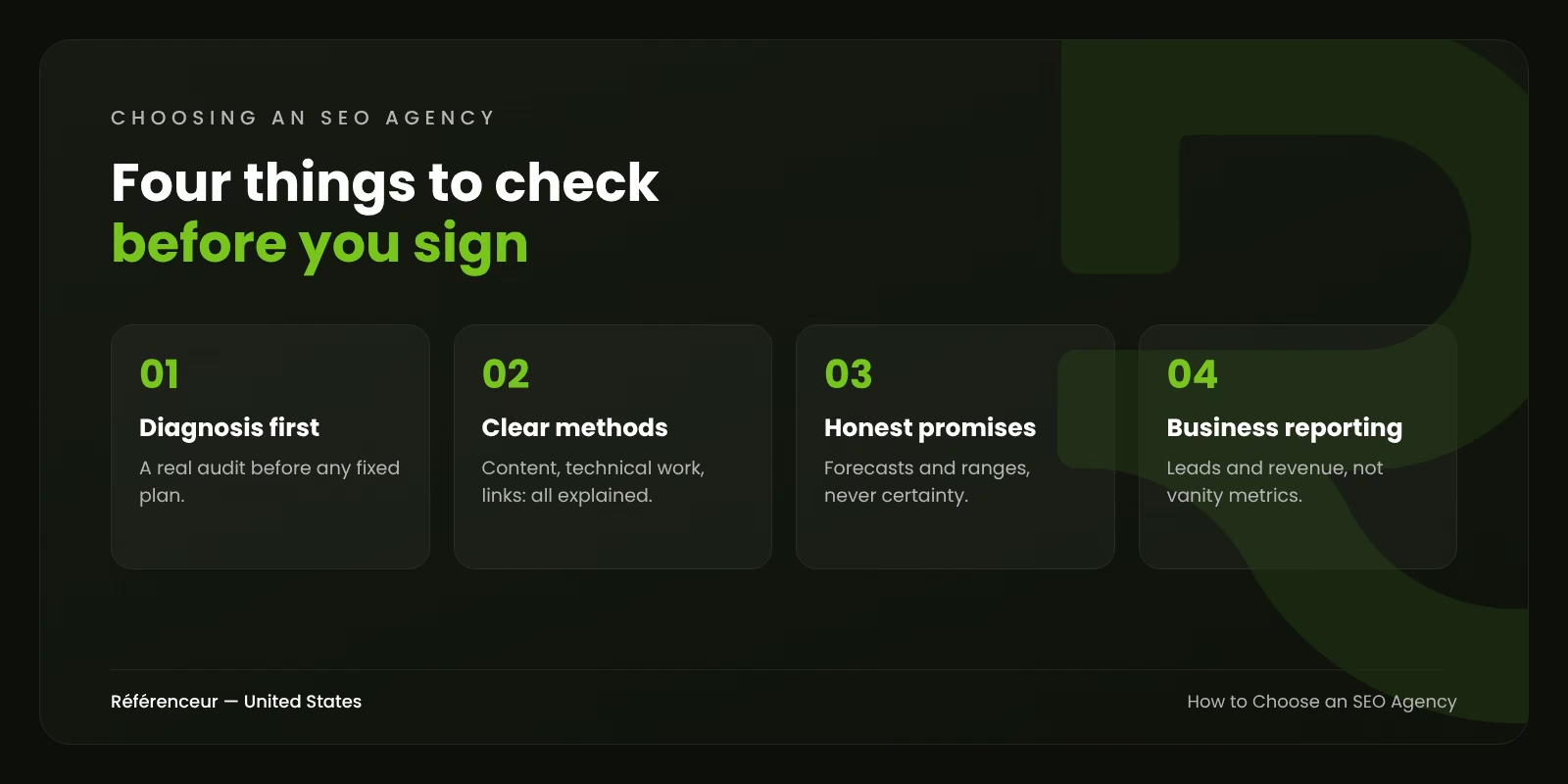
Diagnosis. Did the agency look at your site before proposing? A proposal that could apply to any business suggests the agency sells a package, not a strategy.
Priorities. Does the plan say what comes first and why? Good proposals rank work by expected impact and effort.
Scope clarity. Which tasks are included: technical fixes, content creation, local SEO, link earning, reporting? Who implements technical changes, and how many pages of content are planned?
Measurement. Are the KPIs tied to your business goals? Does the agency plan to set up conversion tracking if it’s missing?
Realism. Look for ranges and scenarios, not certainty. An agency that explains what could slow results down is usually more trustworthy than one that only describes upside.
Fit. Does the team understand your industry, your customers, and your market? For companies with international ties, can they work in the languages and time zones you need?
Step 5: Check References and Track Record Carefully
Ask for case studies that resemble your situation in industry, size, or market, and ask what the agency would do differently next time. Read reviews on Google and other platforms, and look at how the agency responds to criticism. If an agency claims experience in your market, ask for specifics.
Be fair, too. A newer agency or one without U.S. references may still be strong; ask how they’ll prove value early and what they’ll report in the first months.
Step 6: Know What a Healthy First 90 Days Looks Like
The first three months set the tone. A typical healthy engagement includes:
- Weeks 1 to 3: onboarding, access to Search Console and Analytics, a kickoff meeting, and a technical and content audit.
- Weeks 3 to 6: a prioritized roadmap, keyword and page mapping, and fixes to critical technical issues.
- Weeks 6 to 12: new or improved pages for priority topics, local SEO work if relevant, the first link-earning efforts, and a first full monthly report.
By day 90, you shouldn’t expect transformed results, but you should understand exactly what has been done, why, and what comes next. Early signs of progress often show up as more pages indexed, more impressions in Search Console, and better rankings for long-tail searches. For a broader view of what SEO looks like now, see our guide to SEO in 2026.
In-House, Freelancer, or Agency?
Part of learning how to choose an SEO agency is deciding whether you need one at all.
A freelancer can be a great fit for a focused need and a smaller budget. An in-house specialist makes sense when SEO is central to the business and there’s enough work for a full-time role. Agencies bring a team with mixed skills (technical, content, and analytics), plus tools and experience across many sites. Many companies combine models: an in-house marketer who owns strategy, supported by an agency for execution and expertise.
How Référenceur Approaches This
Since you’re reading this on our site, here’s how we work, so you can apply the same scrutiny to us. Référenceur is a digital marketing agency headquartered in Europe, with offices in Belgium and Luxembourg and more than 15 years of SEO work. There’s no U.S. office: American companies work with us through video calls, shared screens, and monthly reports. Every engagement starts with an assessment, we never promise rankings, and your accounts and content stay yours. We’re a Google Partner with an average of 4.7/5 from 107 Google reviews. Learn more on our SEO agency page, or request a free assessment and ask us the questions above.
Frequently Asked Questions About Choosing an SEO Agency
How Long Should I Give an SEO Agency to Show Results?
Expect early indicators, such as technical fixes, indexing improvements, and long-tail ranking gains, within the first three months. Meaningful growth in leads or sales usually takes six to 12 months, depending on competition and your starting point.
Is a Monthly Retainer Better Than a One-Time Project?
It depends on your needs. A one-time audit or migration project works for a defined problem. Ongoing growth through content, links, and continuous technical work usually requires a retainer.
Should an SEO Agency Also Write Our Content?
Many do, and it often makes sense. But the best content combines the agency’s SEO and writing skills with your team’s expertise. Plan to provide interviews, reviews, or expert input.
Can I Hire an SEO Company That Isn’t Based in the U.S.?
Yes, as long as they write in native U.S. English, understand American search behavior, and can schedule meetings at times that work for both time zones. Ask how they handle communication, time zones, and reporting.
What Should Be in an SEO Contract?
Scope of work, deliverables, reporting frequency, account ownership, notice period, and what happens to content and data if you end the relationship. Avoid contracts that give the agency ownership of your accounts.
Is It a Red Flag If an Agency Doesn’t Promise Results?
No, the opposite. Honest agencies explain what they’ll do, how they’ll measure it, and what results are realistic, without promising rankings they don’t control.