 0498 70 98 60
Law Firm SEO Miami: Trilingual Pages Built Around Florida Bar Rules
Law firm SEO Miami projects run into a rulebook that few states match. The Florida Bar regulates what your website says, reviews many of your ads before they run, and expects every required disclosure to appear in the language of the ad itself. For a firm that publishes in English, Spanish, and Haitian Creole, that turns every translated page into a compliance question. Référenceur was founded in Belgium, has a second office in Luxembourg, and writes natively in French and English, so a client who reads your site in French, from Port-au-Prince, Paris, or Brussels, is someone we know how to address. Request a free assessment of your current pages before you translate another one.
Your Website and Your Ads Follow Different Florida Bar Tracks
Florida separates what a firm publishes on its own site from what it pays to put in front of people. The Bar’s Ethics and Advertising Department describes the system this way, as of its July 2026 update:
| Channel | Must it be filed with the Bar? | What that means for your marketing |
|---|---|---|
| Your firm’s own website, including pop-ups on it | No, exempt from filing | Still subject to the substantive advertising rules |
| Your own social media pages and video channels | No, unless posts or videos are sponsored | Boosted posts move into the filing track |
| Television, radio, print, and internet ads | Yes, unless limited to safe harbor content under Rule 4-7.16 | Plan for review time before launch |
| Unsolicited direct mail and email | Yes, always, at least 20 days before use | Never exempt under the safe harbor exceptions |
Since July 1, 2026, the filing fee has been $250 per ad filed at least 20 days before first use and $750 per ad filed late. The Bar responds within 15 days of receiving a complete filing, and it opened online submission through the MyFloridaBar Member Portal in July 2026. Changing an ad’s wording, images, layout, or color makes it a new ad with a new fee, unless the change only fixes a problem the Bar identified.
The practical lesson for Miami attorney marketing: keep your organic content on your website, built with an experienced SEO agency team, where it isn’t filed, and keep paid creative stable once it’s approved. Nothing here is legal advice. Your firm’s ethics counsel, or the Bar’s own department, has the final word.
What Every Practice Page Needs Under Rules 4-7.12 to 4-7.15
The Bar’s checklist for lawyer websites, social media pages, and video channels (revised August 21, 2023) gives a useful page-by-page review list. We build these points into page templates so they don’t depend on someone remembering them:
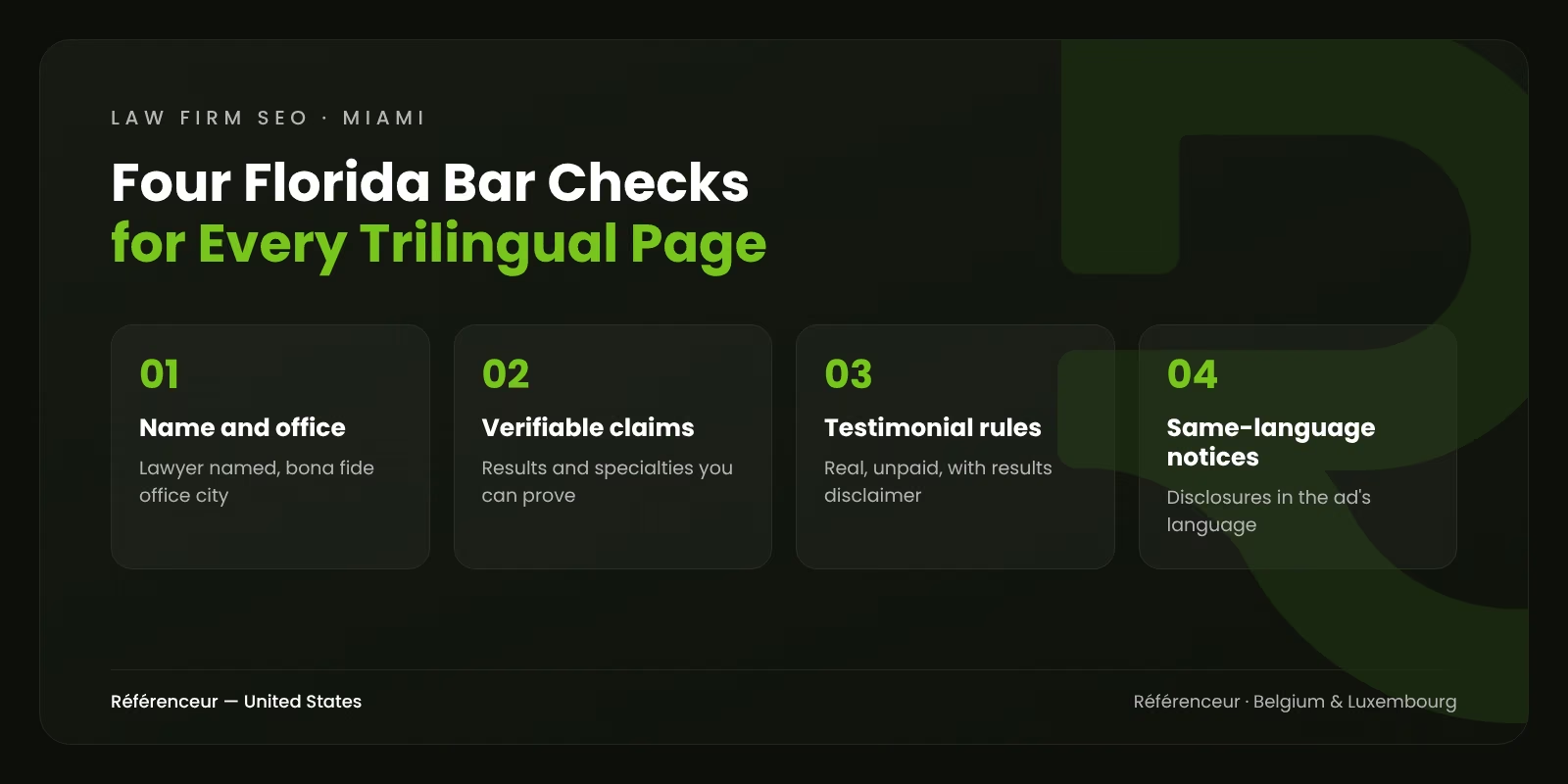
- A named lawyer. At least one lawyer, the firm, or a qualifying provider must be named, legibly and conspicuously (Rule 4-7.12(a)(1)).
- A real office location. The city, town, or county of at least one bona fide office of the advertising lawyer (Rule 4-7.12(a)(2)).
- Referral disclosure. If cases go to another firm, the page has to say so (Rule 4-7.12(b)).
- Verifiable results only. Past results must be objectively verifiable and can’t omit material information; predictions of success are barred (Rules 4-7.13(a)(2), (b)(1), (b)(2)).
- Testimonials with conditions. Under Rule 4-7.13(b)(9), a testimonial must reflect the person’s real experience, can’t be paid for or drafted by the lawyer, must be representative, and needs a disclaimer that prospective clients may not get the same or similar results.
- Fee language with cost disclosure. “No fee unless we win” style statements must say whether the client still owes costs without a recovery (Rule 4-7.14(a)(7)).
- No “approved by The Florida Bar.” Rule 4-7.13(b)(10) forbids stating or implying Bar approval.
One Disclaimer, Three Languages: Building Trilingual Pages
Rule 4-7.12(c) is the one multilingual sites most often miss. When an advertisement appears in a language other than English, the required disclosures have to appear in that language too. A Spanish testimonial page with an English-only disclaimer, or a Creole video with English captions on the cost notice, fails the Bar’s own checklist.
Demand for those languages is real. Spanish is the most common home language in Miami-Dade, the county has a large Haitian Creole-speaking community, and the City of Miami’s language access plan, citing 2018 American Community Survey data, says 33.6% of county residents speak English “less than very well.”
How we structure a trilingual site so translation never breaks compliance:
- One URL per language, linked with hreflang for multilingual SEO, so Google serves the Spanish page to Spanish searchers and the Creole page to Creole searchers.
- Disclosures stored as translated components, reviewed once by a lawyer fluent in that language and reused on every page.
- Language-specific intake: a Spanish form routes to Spanish-speaking staff, and a page in Creole never promises a Creole-speaking lawyer the firm doesn’t have.
- French as an option, not a default, for firms whose Haitian, Canadian, or European clients prefer it.
Our multilingual website design page for Miami covers the build side in more detail.
Immigration Lawyer Marketing Miami Firms Can Defend
Immigration lawyer marketing in Miami leans heavily on credentials, and Florida is strict about how they’re described. Only a board-certified lawyer may claim certification, only in the certified area, and a law firm itself may not claim certification. Claims of specialization or expertise must be objectively verifiable through certification, education, training, experience, or substantial involvement. If a firm claims a specialty that not all of its lawyers meet, the ad needs a clear disclaimer.
The Bar’s Immigration and Nationality Law certification requires at least five years of practice, at least 40% of practice in the field during the three years before applying, 50 hours of approved CLE in that period, peer review, and a written exam. A lawyer who has earned it should have that credential stated in their bio, their structured data markup, and their Google Business Profile description. A lawyer who hasn’t should be described with verifiable facts instead: years in practice, languages spoken, and matters handled.
That precision also helps visibility in AI search. An assistant summarizing “board-certified immigration lawyers in Miami” can only cite what your pages state clearly and consistently.
Cross-Border Firms: Foreign Legal Consultants and Clients Abroad
Miami firms often serve clients from Latin America and Europe, and some work alongside lawyers admitted abroad. Florida lets those lawyers be certified as foreign legal consultants under Chapter 16 of the Rules Regulating The Florida Bar, with clear limits. They must have practiced for at least three of the five years before applying, may advise only on the law of their country of admission, and may not advise on Florida or U.S. law.
The title rule matters for your website. Rule 16-1.3(b) allows only “Foreign Legal Consultant, Not Admitted to Practice Law in Florida,” and the foreign title may appear only alongside the country’s name and that designation. Bio pages, schema markup, LinkedIn profiles, and directory listings should all use the same wording. A French-language bio for an avocat admitted in Paris is a natural fit for us to draft, with the designation kept intact.
For clients abroad, pages target searches made from Bogotá, Madrid, or Brussels, not just Brickell. That means content in the client’s language about U.S. matters handled by your Florida-admitted lawyers, and country-targeted hreflang where it fits.
Why a Francophone Agency in Europe Fits a Miami Practice
Référenceur has no Florida office and no U.S. office at all. Strategists in Francorchamps, Belgium, and Wemperhardt, Luxembourg, run your project, meet your attorneys over video, and send a monthly report that ties each page to consultation requests. The agency brings more than 15 years of SEO practice, 107 Google reviews averaging 4.7/5, and Google Partner status alongside Microsoft Advertising, Semrush, and HubSpot partnerships. The clients we name are businesses in Europe.
A Belgian and Luxembourgish agency, French-speaking by origin and fluent in English, brings something specific to a Miami firm: we can write and check your French pages ourselves and coordinate the Spanish and Creole versions with your bilingual staff or legal translators.
Related reading: the nationwide SEO for law firms page, our Miami SEO agency page, the Miami digital marketing hub, and our page on law firm SEO in New York, where the rules took a very different turn in 2026.
Get a Free Assessment covering your firm’s English, Spanish, and Creole pages.
Frequently Asked Questions About Law Firm SEO in Miami
Do We Have to File Our Website With The Florida Bar?
No. The Bar exempts a firm’s own website from filing, including pop-ups on it. Every page must still comply with the advertising rules, and the Bar’s checklist notes that you can voluntarily file specific items for review, for a fee, if you want certainty before launch.
Do Our Google Ads Need to Be Filed?
Internet ads are on the filing track unless their content is limited to the safe harbor information in Rule 4-7.16, such as name, location, contact details, practice areas, and fee information. A short ad that sticks to that list may be exempt; one that adds claims or testimonials goes to review. Ask counsel to confirm each format.
Can We Publish Spanish-Language Client Reviews on Our Site?
Yes, if they meet the testimonial conditions in Rule 4-7.13(b)(9) and the disclaimer about results appears in Spanish next to them. We also avoid editing a client’s words, since the rule bars testimonials written or drafted by the lawyer.
Does a Sponsored Instagram Post Count as an Ad?
Yes. The Bar’s checklist says your own social pages don’t need filing unless posts or videos are sponsored. Once you pay to boost a post, treat it like any other internet ad and plan for the 20-day filing window.
How Do You Fit the Bar’s Review Period Into a Campaign Calendar?
We plan paid creative at least four weeks out, so the 20-day filing window and the Bar’s 15-day response time don’t delay a launch. Organic content on your website isn’t filed, so it can move faster, with your attorneys reviewing each draft. To set up that calendar for your practice, request a free assessment.