 0498 70 98 60
Diners decide fast. Someone types “tacos near me,” “best brunch downtown,” or “Italian restaurant open now,” glances at the map, checks a few photos and the star rating, and picks. The decision often takes less than a minute. Restaurant SEO is about being one of the three places they see, with the information that makes them choose you.
Référenceur helps independent restaurants, small groups, and multi-location concepts get found in Google Search, Google Maps, and AI assistants. We’ve done this work from Europe for more than 15 years. Our clients there include Lupulus, a beer brand that knows how much hospitality runs on reputation, and our own Google rating stands at 4.7/5 across 107 reviews. U.S. restaurants work with us from a distance. Get a free assessment to see exactly what a hungry person nearby sees when your restaurant comes up.
A Crowded Market Where Details Win
The National Restaurant Association counts more than 1 million restaurant and foodservice locations in the U.S. and projects industry employment of 15.8 million jobs in 2026. In most neighborhoods, that means dozens of options within walking or driving distance, all competing for the same searches.
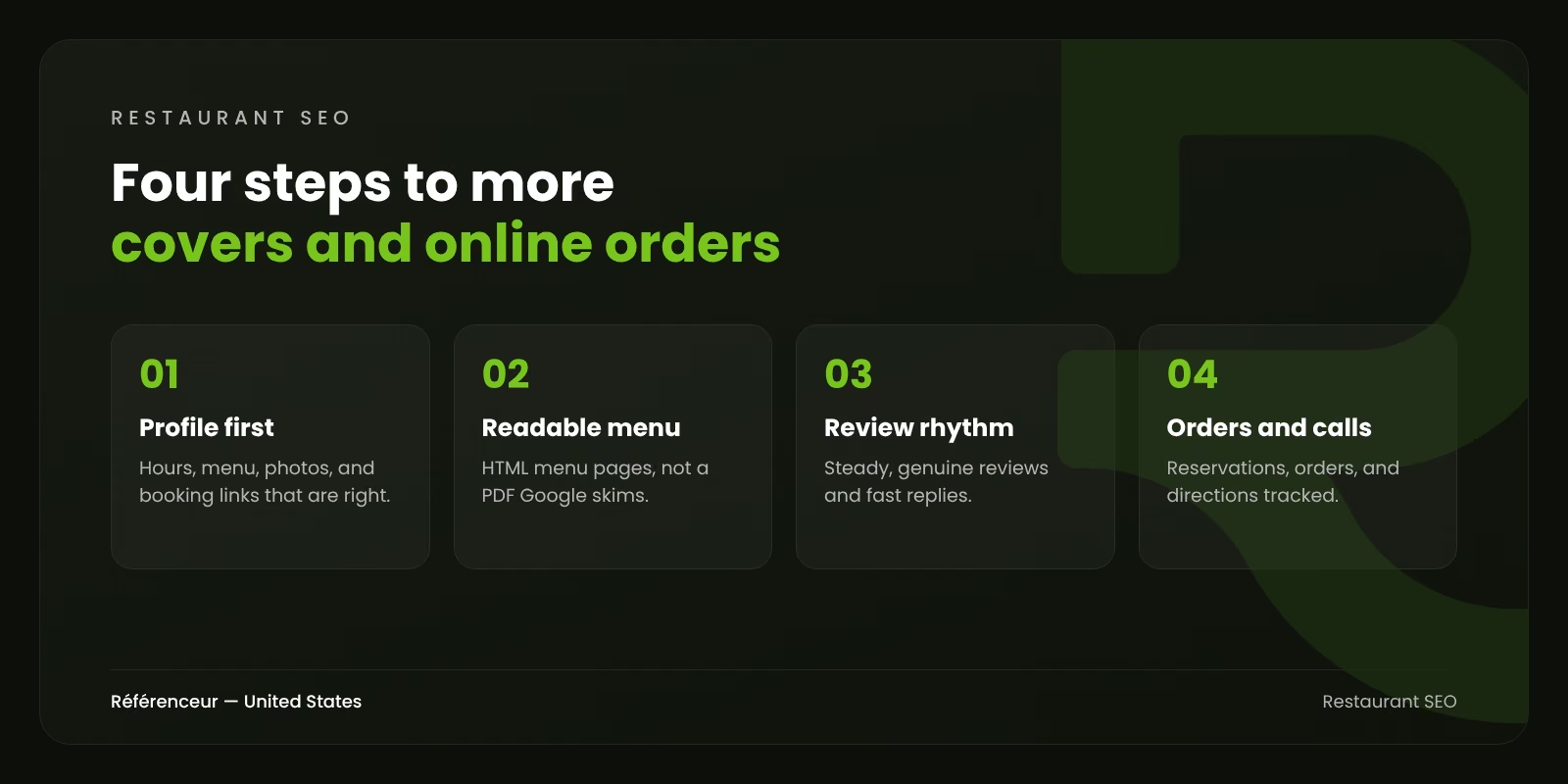
In that environment, small details decide who gets the reservation:
- Accurate hours, including holiday hours. Few things lose a customer faster than showing up to a locked door.
- A menu Google can read. A PDF or a photo of a printed menu is hard for search engines and AI tools to interpret. An HTML menu page with dish names and short descriptions can be found for searches like “vegan ramen” or “gluten-free pizza.”
- Recent, real photos of your dishes, dining room, and exterior, so people recognize the place when they arrive.
- Working links for reservations, online ordering, and directions.
- Fresh reviews with thoughtful replies from the owner or manager.
What Our SEO for Restaurants Includes
| Task | What we handle | What diners notice |
|---|---|---|
| Restaurant Google Business Profile | Primary and secondary categories, attributes (outdoor seating, kid-friendly, delivery), hours, special hours, menu, photos, booking and order links | A complete, trustworthy listing in Maps |
| Website menu | Indexable menu pages with dishes, dietary labels, and prices kept current by your team | Your dishes appear for specific cravings |
| Location pages | For groups, one page per location with its own hours, address, photos, and events | Each location ranks in its own neighborhood |
| Reviews | A request routine for staff, reply guidelines, and monitoring across platforms | More reviews and visible owner engagement |
| Technical SEO | Speed, mobile layout, schema markup for restaurant, menu, and location details | Faster pages and clearer data for Google |
| Events and seasonal pages | Brunch, happy hour, private dining, catering, holiday menus | Visibility for high-intent occasion searches |
Restaurant Local Search Beyond Google
Google is the biggest source of discovery, but it isn’t the only one. Apple Maps, Yelp, TripAdvisor, OpenTable, and delivery apps also show your name, hours, and reviews. Inconsistent information across these platforms confuses diners and weakens trust signals. We audit your listings and help you align the core details: name, address, phone number, hours, and website. Our Google local SEO guide walks through the basics.
AI assistants add another layer. Ask ChatGPT or another AI assistant for “a quiet place for a business dinner in Midtown” or “a kid-friendly brunch spot with outdoor seating,” and the reply is assembled from listings, reviews, menus, and articles. Restaurants with consistent, detailed information across the web are easier for these tools to recommend, which is why your website matters for local AI search. That’s why our restaurant local search work treats your website, profiles, and reviews as one system.
Catering, Private Events, and Seasonal Demand
Some of a restaurant’s most profitable business never shows up in “near me” searches. Office managers search for “corporate catering” or “private dining room for 30 people,” and couples look for rehearsal dinner venues months ahead. A dedicated page for each of these services, with capacity, sample menus, and a simple inquiry form, can rank for those searches and bring in larger checks. Seasonal pages, such as holiday parties, Thanksgiving takeout, or Mother’s Day brunch, should go live weeks before the date, since people plan early and Google needs time to find the page.
Reviews Without Shortcuts
A restaurant’s rating is often the deciding factor. The temptation to boost it artificially is real, but the risks are serious. Since October 2024, the FTC has banned fake reviews, undisclosed reviews from insiders, and perks offered in exchange for praise. Google also removes reviews it considers incentivized or fake.
What works is a rhythm: train staff to mention reviews at the right moment, put a QR code with your review link on receipts or table cards, and reply to every review, especially the critical ones, calmly and specifically. A thoughtful reply to a two-star review often reassures future diners more than 10 five-star ones. Our framework for responding to negative reviews includes real examples.
How We Work With Restaurants
Our team isn’t in the U.S.; we’re in Belgium and Luxembourg, around six hours ahead of the East Coast. Restaurant owners are busiest at night, so a mid-morning call usually suits everyone.
- A short video call with the owner or marketing lead to understand your concept, peak times, and goals.
- An audit of your Google Business Profile, website, listings, and competitors nearby.
- Quick fixes first: hours, categories, menu, photos, links.
- Ongoing work: content for events and private dining, review routine, location pages.
- A monthly report on calls, direction requests, reservations, and online orders.
Our agency holds partner status with Google, Microsoft Advertising, Semrush, and HubSpot. To see how this fits our wider methodology, visit our SEO agency page. Restaurants in major cities can also explore our U.S. locations, including restaurant marketing in New York and restaurant marketing in Los Angeles. For French bistros, bakeries, and wine bars that want to reach French-speaking visitors and expats, we write menus and pages in both languages.
Get a free assessment and see your restaurant the way tonight’s diners see it before they choose.
Frequently Asked Questions About Restaurant SEO
Is a Google Business Profile Enough for a Restaurant?
It’s the most important piece, but not the only one. A good website with an indexable menu, accurate listings on other platforms, and steady reviews all reinforce your profile and help you appear for more specific searches.
Should I Put My Menu Online as a PDF?
You can keep a PDF for people who want to print it, but publish the menu as a regular web page too. Search engines and AI tools read text on a page far more reliably than a PDF or an image.
How Can a New Restaurant Get Reviews Quickly?
Ask every satisfied guest, make the link easy to reach with a QR code, and reply to every review. Buying reviews or rewarding positive ones breaks federal rules and Google’s policies, and those reviews can disappear.
Does Restaurant SEO Work for Multiple Locations?
Yes. Each location needs its own Google Business Profile and a dedicated page on your website with its own hours, address, and details. We set up a structure that scales as you open new locations.
Should We Also Advertise on Google?
Paid ads can help with launches, catering, or private events. Our Google Ads agency team can run campaigns when it makes sense. Request a free assessment and we’ll advise you on the right mix.