 0498 70 98 60
AI Search Optimization in Seattle: Get Your Business Cited by AI
Ask Copilot for “machine shops near Seattle with AS9100 certification” and you won’t get 10 blue links. You get a short answer naming three or four companies, often with a source next to each. Being one of those names is now a sales channel, and in a city where Microsoft builds Copilot, your buyers are among the earliest to rely on it.
Our AI search optimization service in Seattle, also called generative engine optimization (GEO), helps companies get cited by ChatGPT, Microsoft Copilot, Gemini, Perplexity, and Google’s AI Overviews and AI Mode. We write for American buyers in native U.S. English. For subsidiaries of European or Quebec companies and French-speaking founders, we also cover answers given in French and can run the whole project in French.
Référenceur has worked in search for more than 15 years and holds a 4.7/5 rating from 107 Google reviews, with Google, Microsoft Advertising, Semrush, and HubSpot as partners. Get a free assessment of how AI engines see your company: we test the questions your buyers ask and show you who gets named instead of you.
In Seattle, Buyers Ask AI Before They Call
AI assistants are mainstream. A Pew Research Center (2026) survey found that 44% of U.S. adults have used ChatGPT, rising to 55% among adults aged 30 to 49. Google brought AI Overviews to U.S. search in May 2024, then opened AI Mode to all U.S. users in May 2025.
Seattle sits at the center of this shift. The Seattle-Bellevue-Kent area had about 1.51 million nonfarm jobs in mid-2025 according to HUD, with heavy concentrations in software, cloud, aerospace, and life sciences. Engineers and product managers in those fields adopt new tools quickly, and they increasingly use assistants to build a vendor shortlist before visiting any website.
Microsoft’s ecosystem deserves special attention here. Copilot draws on Bing’s index, and since February 2026 Bing Webmaster Tools has offered a public preview of an AI performance report showing when your pages are cited in Copilot. For B2B companies selling to Windows-heavy enterprises, that data is worth reviewing every month.
The practical consequence is simple. If your site is invisible to Bing, poorly described in directories, or vague about what you actually do, AI engines fill the gap with a competitor who explains it better. We see the same pattern across industries: the companies cited most often aren’t always the biggest. They are the ones whose pages answer questions plainly, list concrete specifications, and match what independent sources say about them.
What Our Seattle AI Search Optimization Includes
GEO builds on solid SEO. Google states that AI Overviews and AI Mode have no extra technical requirements: a page must be indexed and eligible to appear with a snippet. The difference lies in how clearly your content answers questions and how consistently other sources describe you.
- Question bank: 30 to 50 real questions from your buyers, in English and in French where relevant, tested across the main AI engines.
- Baseline report: dated answers from each engine, the companies named, and the sources cited.
- Entity consistency: company name, address, services, languages, and service area identical across your site, listings, and directories.
- Answer pages: one clear page per important question, with facts, numbers, and examples that are easy to quote.
- Structured data in schema.org that matches the visible text exactly.
- Crawler access: Googlebot, Bingbot, OAI-SearchBot, and PerplexityBot checked in robots.txt, your firewall, and your CDN.
- Third-party proof: industry directories, associations, local press, and detailed reviews that confirm what your site says.
- Monthly tracking: the same questions re-run, AI referral traffic measured, and findings explained.
We don’t sell shortcuts. A file such as llms.txt is not a ranking signal: Google’s John Mueller said in June 2025 that no AI system uses it. Our national AI search optimization (GEO) page covers the method in more depth.
Our 4-Step Process
The schedule below is typical; your market and site size can shift it.
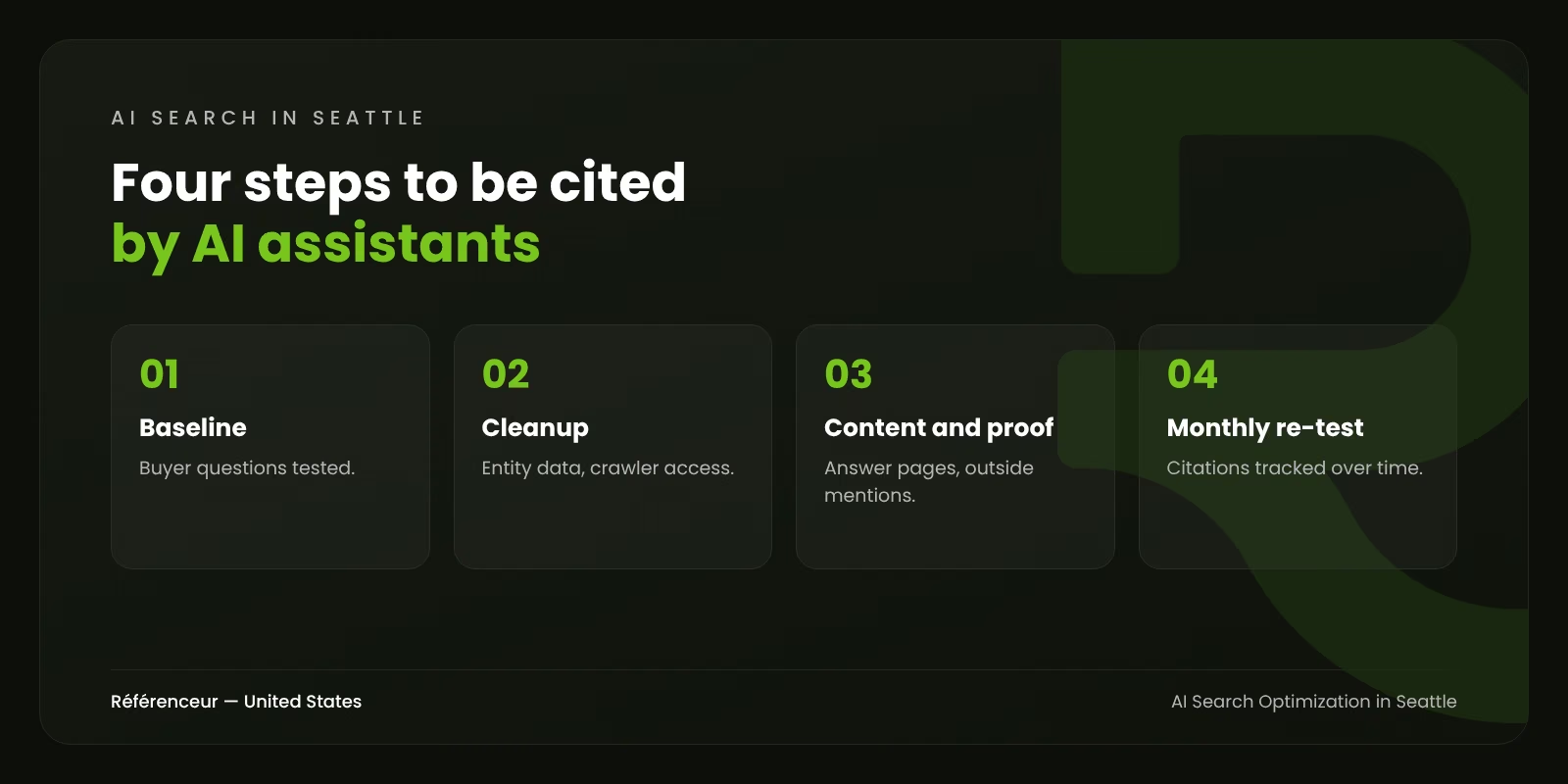
- Baseline: your question bank tested across ChatGPT, Copilot, Gemini, Perplexity, and Google’s AI features. Two to three weeks.
- Cleanup: entity data aligned, crawler access fixed, and structured data corrected.
- Content and proof: answer pages written in English, French where useful, and outreach to the sources AI engines cite.
- Monthly re-test: the same questions asked again, with changes tracked and next steps set.
Results appear gradually. Talk to us about your timeline if a launch or trade show is coming up. Fixing blocked crawlers can help within days, but earning citations from new content and third-party mentions usually takes months. We can’t promise that any engine will cite you, and no honest agency can. We commit to rigorous testing and transparent reporting.
AI Search in Seattle: From Cloud to Aerospace, Different Questions
Each industry gets asked different things. These examples are illustrative.
| Business profile | Typical question asked of AI | What must exist to be cited |
|---|---|---|
| French SaaS company in Bellevue | “Best HR software alternatives for mid-size manufacturers” | Honest comparison page, public documentation, verified reviews |
| Aerospace supplier near Everett | “AS9100 certified machining shops in Washington State” | Detailed certifications, capabilities with figures, industry directory listings |
| Biotech supplier in King County | “Lab reagent suppliers with next-day delivery in Seattle” | Indexable catalog, explicit delivery terms, marked-up product pages |
| Franco-American tax firm | “Accountant for French expats in Seattle” | Pages by situation in English and French, named authors |
| French bakery or specialty grocer | “Où acheter du pain français à Seattle ?” | Complete Google Business Profile, exact hours, recent reviews, bilingual site |
Why Choose Référenceur for GEO in Seattle
AI engines reward clarity and consistency, and that is where AI search optimization in Seattle starts. Our job is to make your company easy to understand, verify, and quote, in both of your languages.
- SEO, AI search, and ads handled by one team, so your content serves every channel.
- Native American English for U.S. buyers, French for the community and headquarters.
- Documented tests with screenshots and dates, not vague “visibility scores.”
- A single contact who explains results in plain language.
We work from Francorchamps, Belgium, and Wemperhardt, Luxembourg, without any U.S. office. Video calls happen at a time that works for both time zones, and the client stories on our case studies page are European.
Channels That Feed Your AI Visibility
AI answers often draw on pages that already rank. Our SEO agency in Seattle builds that foundation. For ChatGPT specifically, including ChatGPT Ads, see ChatGPT SEO in Seattle. Every channel is summarized on our digital marketing agency in Seattle page, and Bay Area companies can visit AI search optimization in San Francisco.
Request a free assessment of how AI engines describe your company. You’ll get the answers we recorded, the competitors cited, and an action plan priced in U.S. dollars.
Seattle AI Search Optimization FAQ
Is GEO Different From SEO?
It builds on SEO. Rankings, technical health, and authority still matter. GEO adds work on answer clarity, entity consistency, and third-party mentions, then measures citations inside AI answers.
Which AI Engines Matter Most for Seattle Companies?
It depends on your buyers. Business users often rely on Copilot and ChatGPT, while consumers lean on Google’s AI features. Your baseline test shows where competitors are already being cited.
How Do You Measure AI Visibility?
We re-run the same questions each month and record mentions and sources. We also track referral visits from AI assistants in GA4, including ChatGPT links tagged with utm_source=chatgpt.com.
Should We Block AI Crawlers?
Blocking training crawlers like GPTBot is your choice. Blocking search crawlers such as OAI-SearchBot or Bingbot, however, can keep you out of AI answers. We review each one with you.
Do We Need French Content for AI Answers?
Only if part of your audience asks questions in French. AI engines generally answer in the language of the question and favor sources in that language, so English remains the priority for U.S. buyers.