 0498 70 98 60
AI Search Optimization in Burlington, VT: Cited in English and in French
A family in Laval asks ChatGPT, in French, for a lakeside inn near Burlington with good family activities. A procurement lead in Williston asks Google’s AI Mode for machining suppliers in Chittenden County. In both cases, an AI tool writes a short answer and names a handful of businesses. The companies left out of that answer simply aren’t considered.
AI search optimization in Burlington, VT, also known as generative engine optimization (GEO), makes your business clear, verifiable, and quotable for answer engines. Because so much of Burlington’s business crosses the border, we work in two languages: native American English for U.S. buyers and French adapted for Quebec. That bilingual GEO is rare among New England agencies, and it’s the core of what we offer here.
More than 15 years in search, 4.7/5 across 107 Google reviews, and partnerships with Google, Microsoft Advertising, Semrush, and HubSpot. Get a free assessment of your AI visibility, and we’ll run the questions your customers ask, in both languages.
Burlington’s Two Markets Ask AI Different Questions
Quebec customers ask in French, and they ask differently. A traveler from Montreal writes “fin de semaine,” “souper,” or “pourvoirie,” vocabulary that a translation from English often misses. If your French pages don’t use those words, AI tools are less likely to match your business to the question. With Canadian land trips to the U.S. down 31% in 2025, according to WCAX, the businesses that stay clearly present in French will be the ones AI tools recommend when travelers return.
American buyers bring their own questions. The UVM Medical Center employs more than 8,200 people, GlobalFoundries runs Vermont’s largest industrial site in Essex Junction, and Beta Technologies planned to nearly double its Vermont workforce, according to VTDigger in December 2025. Their suppliers and contractors are judged by procurement teams that increasingly start research in an AI tool.
Adoption is broad. According to Pew Research Center (2026), 44% of U.S. adults use ChatGPT, and Google opened AI Mode to every U.S. user in May 2025. In Canada, the same assistants answer in French, which makes your French content part of the evidence these tools weigh.
Consistency ties it all together. AI engines compare your website, Google Business Profile, directories, and press mentions. If your English and French pages disagree on hours, prices, or services, the engines hesitate to cite you at all.
Different Profiles, Different Questions
Each type of business needs its own question panel. Five profiles we often see around Lake Champlain:
| Company profile | Typical question asked of AI | Priority work |
|---|---|---|
| Lakeside inn or hotel | “Auberge familiale près de Burlington au Vermont” | French pages with Quebec vocabulary, consistent prices, and recent detailed reviews |
| Industrial supplier near Essex Junction | “Precision machining suppliers in Chittenden County” | Capabilities and certifications in plain text, case studies, and industrial directory listings |
| Maple or specialty food producer | “Best Vermont maple syrup brands that ship to Canada” | Product data, shipping policies, and mentions in food media |
| Quebec subsidiary in northern Vermont | “Canadian manufacturers with U.S. plants in Vermont” | A U.S. presence page, aligned French and English versions, and trade association listings |
| Cross-border relocation or accounting firm | “Comptable qui connaît la fiscalité Canada–États-Unis à Burlington” | One answer page per question, named experts, and both languages kept in sync |
What Our AI Search Optimization Service Includes
The scope is set after the assessment. It typically includes:
- A bilingual question panel: 30 to 60 real customer questions in English and French, tested on AI Overviews, AI Mode, ChatGPT, Gemini, Perplexity, and Microsoft Copilot.
- An entity audit: name, address, phone, services, and languages spoken compared across your site, Google Business Profile, LinkedIn, Tripadvisor or Yelp, and industry directories.
- Schema markup (Organization, LocalBusiness, Service, Product) consistent with what visitors see on each page.
- Answer pages: a direct answer at the top, then details, sources, and proof.
- Third-party mentions: chambers of commerce, tourism boards, trade press, and associations on both sides of the border.
- Crawler access: Googlebot, Bingbot, OAI-SearchBot, and PerplexityBot allowed in robots.txt and not blocked by your firewall.
- Monthly reporting: citations earned per language, competitors cited instead of you, and the sources the engines used.
GEO builds on your SEO; it doesn’t replace it. Our national AI search optimization (GEO) page describes the method in detail.
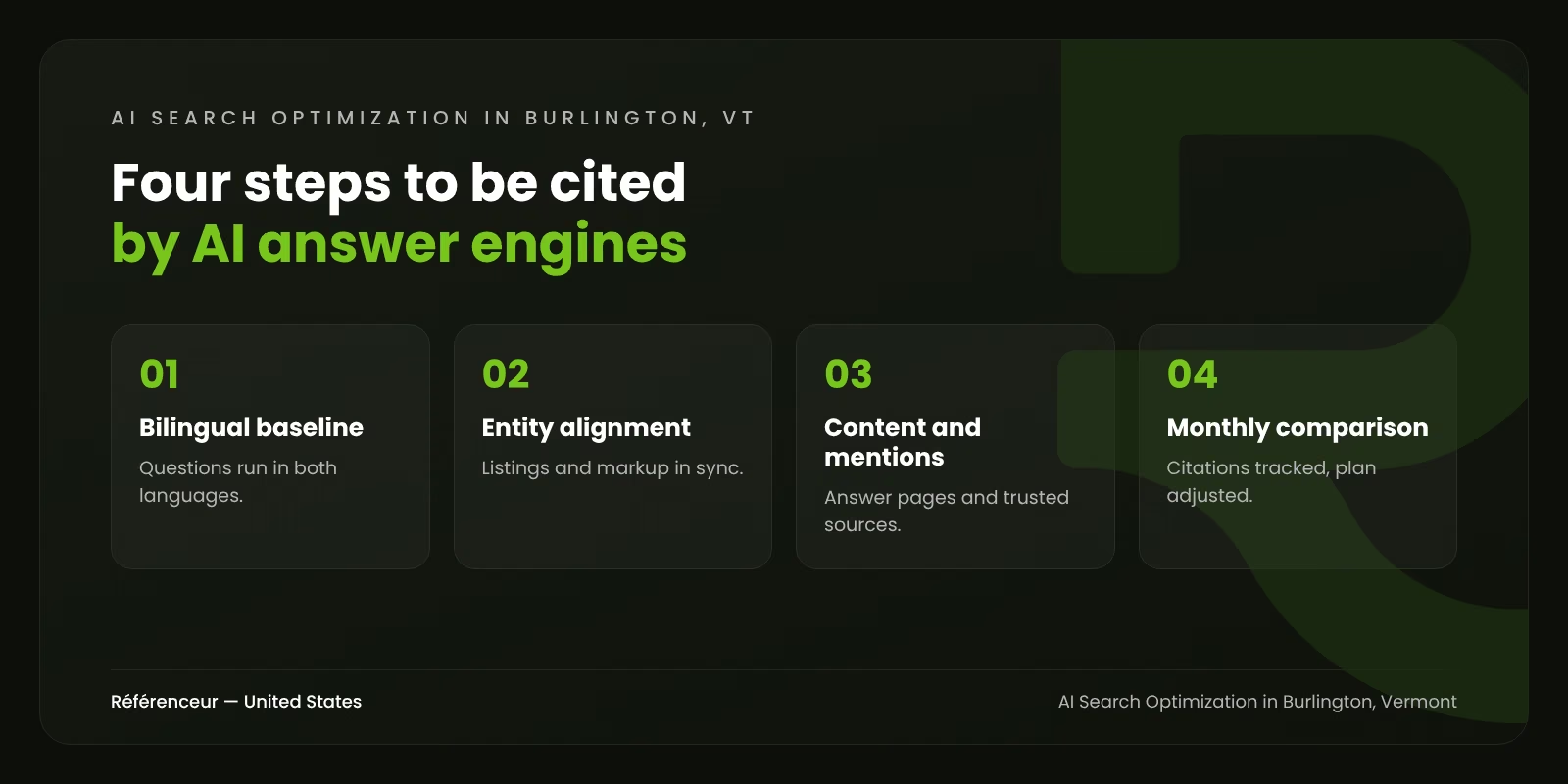
Our 4-Step Process
- Bilingual baseline: your question panel run on each engine in both languages, with answers archived and dated. Typically two to three weeks.
- Entity alignment: listings, directories, and markup corrected so English and French sources tell the same story.
- Content and mentions: answer pages in both languages and outreach to the sources AI tools rely on.
- Monthly comparison: same questions, same engines, results compared with the prior month and the plan adjusted.
Results depend on how often engines recrawl your pages and how crowded your questions are. We can’t promise citations; we measure and improve. To see what AI tools say about you today, book a short video call.
Why Choose Référenceur for GEO in Burlington
GEO mixes SEO, content, structured data, and reputation. We handle all four with one bilingual lead, which matters when half of your evidence is in French. No translation layer distorts your French content. The same person who writes your English answer page checks that the French version states the same facts, prices, and policies, which is exactly the consistency AI engines look for.
We have no U.S. office. Our team works from Francorchamps, Belgium, and Wemperhardt, Luxembourg, and collaborates with Vermont businesses through video meetings, shared dashboards, and monthly reports. Calls usually take place during your morning.
Proof of our work comes from European clients such as Menuiserie Rosen, Isolpur, Lupulus, and Auto-école Georges, presented in our case studies. We don’t claim any U.S. clients.
What Strengthens Your AI Visibility
- Strong organic rankings: AI answers lean on indexed, well-ranked pages. Our SEO agency in Burlington builds that base.
- ChatGPT in detail: citations, crawler settings, and ChatGPT Ads are covered on our ChatGPT SEO in Burlington page.
- A clean bilingual website: proper hreflang, real text, and fast pages. See our web design in Burlington.
- One plan for every channel: our digital marketing agency in Burlington.
Also active in Greater Boston? See AI search optimization in Boston. To see your starting point, request a free assessment: you’ll receive answers to 10 key questions in each language, the competitors cited instead of you, and three priorities.
FAQ About AI Search Optimization in Burlington, VT
Is GEO Different for French-Language Questions?
The principles are the same, but the evidence differs. French answers draw on French sources: your French pages, Quebec directories, and French-language media. That’s why we treat each language as its own panel.
Do We Still Need SEO If We Invest in GEO?
Yes. Google says there are no extra technical requirements for AI Overviews or AI Mode beyond being indexed and eligible to show a snippet. Good SEO remains the foundation; GEO adds clarity, answers, and third-party proof.
How Do You Track Whether AI Tools Cite Us?
By re-running a fixed question panel each month and recording the results. Answers vary, so we look at trends. AI referral visits are also tracked in Google Analytics 4.
What Does GEO Cost for a Burlington Business?
It depends on the number of questions, languages, and pages to create. We don’t publish standard pricing. Once the free assessment is done, you get a written quote in U.S. dollars that lists each deliverable and language.
An AI Tool Gives Outdated Information About Us. Can You Fix It?
We trace the error to its source, often an old listing or article, correct it, and request updates. The next monthly run shows whether the answer changed. Some engines update within weeks; others take longer, because they rely on sources that are refreshed less often, so we keep tracking until the corrected fact appears.