 0498 70 98 60
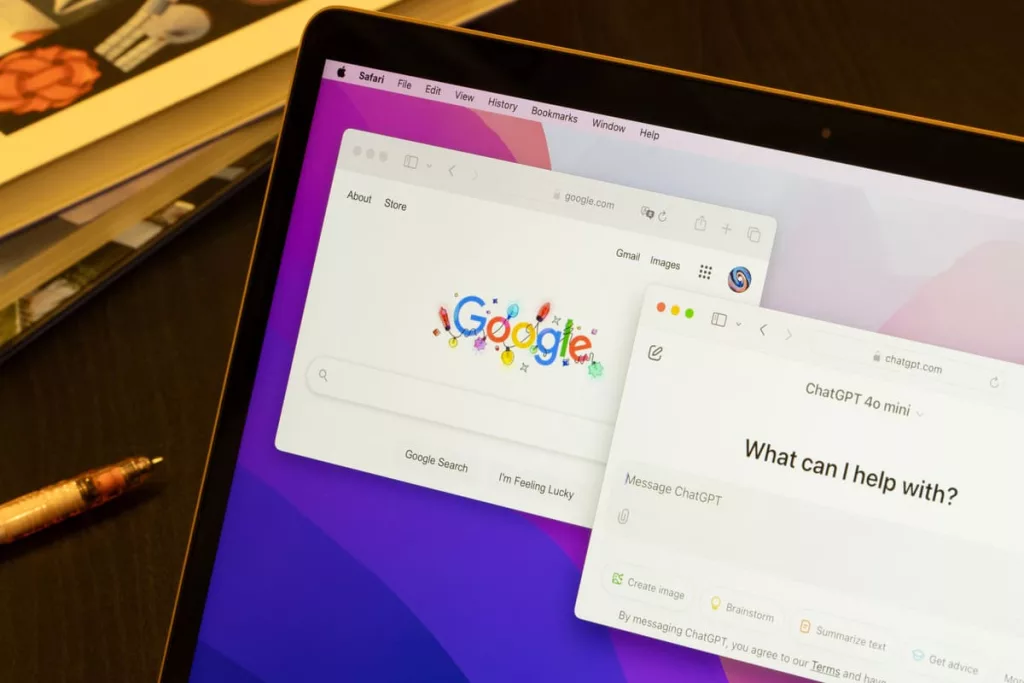
From SEO to GEO: How to Stay Visible When AI Competes With Google
Your customers are asking AI their questions. Is your business part of the answer?
Every day, your potential customers are looking for solutions. But they don’t “search” the way they used to.
For years, the reflex was simple: open Google, type a query, click a link. Today? They open ChatGPT, Perplexity, or Gemini, ask a direct question, and get an instant answer. No click. No visit to your website.
If your business doesn’t show up in these AI-generated answers, you risk becoming invisible to a growing share of your prospects. And the trend keeps accelerating: in February 2026, OpenAI reported that ChatGPT had reached 900 million weekly active users (source: TechCrunch). That’s a lot of opportunities to get cited.
Welcome to the era of GEO (Generative Engine Optimization): the natural evolution of SEO for staying visible now that conversations with AI compete with the search bar.
AI Is Changing the Rules: From Search to Recommendation
AI is redefining how we get informed, search, compare, and buy.
Search engines crawl, analyze, and index websites. Large language models (LLMs) like ChatGPT and Perplexity, on the other hand, synthesize answers from multiple sources (websites, customer reviews, public data, and trusted content) to produce a contextual, conversational response.
Here’s an example:
Scenario 1 – A traditional Google search: the user types “electrician Austin.” Google shows a page of results. They have to click, compare, and browse several websites.
Scenario 2 – An AI search (ChatGPT, Perplexity): the user asks, “Who’s the best electrician in Austin for a home remodel?” The AI answers directly with two or three names, their specialties, and why to choose them. No click. No comparison shopping. Just a recommendation.
→ The difference? In scenario 2, if you’re not mentioned, you don’t exist for that user.
That’s where GEO, Generative Engine Optimization, comes in.
While SEO aims to rank a page, GEO aims to get your brand cited in AI-generated answers.
In short:
- SEO is about earning the click.
- GEO is about earning the mention.
Does that mean SEO is dead? No.
GEO is the logical next step after SEO. Without structured, credible content (SEO), there’s no way an AI can accurately cite your business (GEO).
SEO and GEO: Two Complementary Strategies
It’s the question everyone is asking right now. And the answer is clear: SEO is absolutely not dead. It’s evolving.
Why Do SEO and GEO Work Together?
No solid SEO, no effective GEO.
AI tools pull their information from content that is structured, credible, and well indexed. If your website is poorly optimized, invisible on Google, and thin on quality content, no AI will ever cite you.
GEO doesn’t replace SEO: it extends it, amplifies it, and rewards it.
The Winning Strategy for 2026 and Beyond
Today’s top-performing businesses combine both approaches:
✅ SEO → Attract qualified traffic, convert visitors, and build credibility (performance marketing)
✅ GEO → Get recognized as a go-to source by AI and get cited even when nobody clicks (brand marketing)
Together, they strengthen your digital authority and multiply your touchpoints with future customers.
How to Optimize Your Content to Be Visible Everywhere (SEO and GEO)
Good news: SEO and GEO are built on the same foundation of quality. But if you want to be cited tomorrow, you need to get ahead of it today.
1. Create Clear Content That Showcases Your Expertise
AI favors content that goes deep.
Forget over-optimized copy: explain what you do the way you would to a curious customer.
2. Structure Your Pages
Use:
- A clear heading hierarchy (H1, H2, H3)
- Bulleted lists for anything you enumerate
- FAQs that answer common questions
- Tables to compare your services
- Clear definitions of what you offer
This structure makes your content easier for people to read and easier for AI to analyze.
3. Prioritize Accuracy and Clarity
AI tools tend to select their sources based on three criteria:
Structured format, factual reliability, and semantic clarity.
Tip: Cite your sources, back up your claims with concrete numbers, and avoid vague language.
4. Showcase Your Local Expertise
AI engines love credible content.
Publish your case studies, customer testimonials, and real-world projects: they strengthen your authority in your industry and your market.
5. Test and Adjust
Here’s a simple tip: test your AI visibility.
Ask ChatGPT, Perplexity, or Gemini the key questions your customers ask about your business.
Do you show up in the answer?
✅ If yes: your content is already GEO-ready
❌ If not: your content probably lacks structure, precision, or authority
And if that’s the case, we’re here to help.
Getting Ahead on GEO Already Sets You Apart
SEO isn’t dead.
It’s evolving, just like your business.
GEO isn’t a threat: it’s an opportunity to be visible in a new way. A chance to showcase your expertise even without a click, right inside the answers your future customers get from AI.
At Référenceur, a European agency that works with U.S. businesses remotely, we help small businesses and independent professionals prepare for this transition now, with our AI search optimization (GEO) services:
- Strengthening their SEO to stay visible on Google
- Structuring their content to get cited by AI
- Building the digital authority they need to lead their industry
Want to Know If Your Website Is Ready for the Future of Search?
Contact us for a free assessment. We’ll review your current visibility together, by video call, and map out how to build your presence for what comes next.